It can be organised on the balcony or in the garden, and solutions can be found for all sizes of space to recycle leftovers; you can also opt for ready-made structures, including designer ones, or do-it-yourself. In any case, choosing to have a composter is a huge step in the direction of intelligent and quality recycling, and a decidedly “green”.
The green choice for the home the composter  from waste to compost
Quality for the environment, with the reduction of waste going to composting systems, but also quality of fertiliser that we can use for our houseplants or to feed our vegetable garden with nutrient-rich materials, and produce food of choice again.
A composter closes the virtuous circle in the fight against food waste: food remains in turn become fertiliser for the garden, turning domestic waste into a resource.
 a few simple steps
The basics: what can you put in the composter?
Whatever form we decide to give it, the composter is a aerated container, where the decomposition process of organic matter is promoted.
What you get, after several months, is called compost.
In addition to facilitating the transformation process, the composter avoids unpleasant odours and the presence of various unwanted animals (attracted by the leftovers), to the point of becoming an object that finds its place in gardens without being overly conspicuous.
We can only put organic material in the composter: all vegetable waste from the kitchen and garden, cut flowers, bread, egg shells (preferably shredded), coffee grounds, food scraps, leaves and grass clippings from the garden, animal droppings, ashes and dry materials such as straw and shredded twigs, up to paper and cardboard.
Meat and cheese leftovers to be avoided because they will attract animals but also because they activate other decomposition processes.
What must not go in are inorganic materials such as plastics and metals, but also paper and cardboard treated with glue and ink.
No newspapers, food cartons or repeatedly recycled cartons. 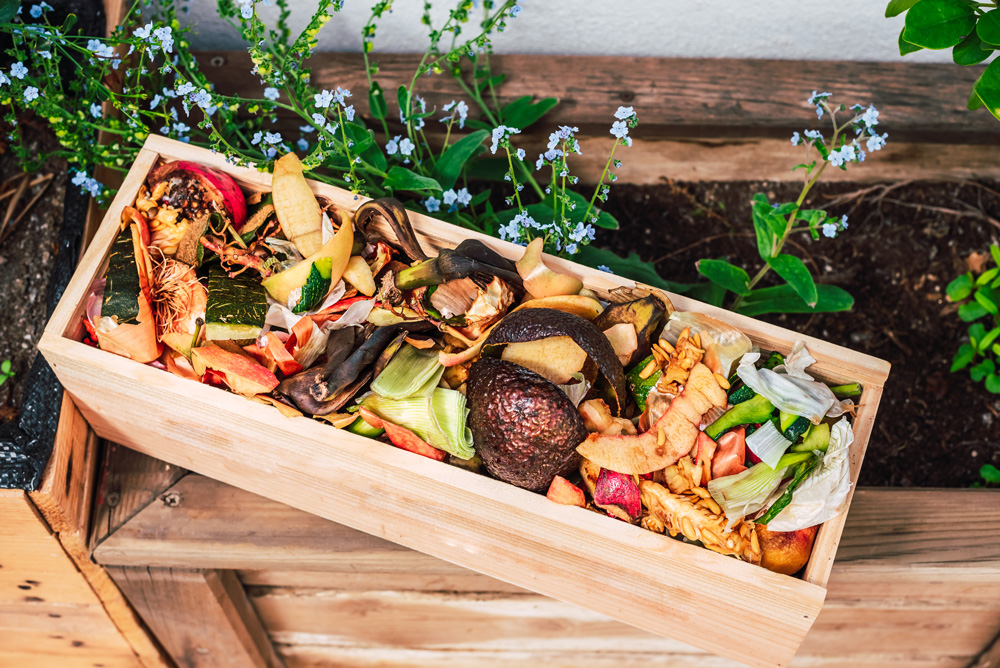 deliver only organic material
How is it done? Layering
Not all organic matter is equal, and a good compost will consist of different materials, appropriately alternated.
A balance between two major families of organic matter: the so-called “green”, nitrogen-rich matter and the “yellow”, dry, carbon-rich matter.
The dry component also ensures aeration, which is essential to promote decomposition.
Just like any natural process, it is always a matter of alternation and balance, including between heat, moisture (it may be necessary to wet the compost) and aeration. Once the composter is placed, directly on the ground, the first layer from the bottom will be a dry layer.
A draining base should be created with twigs and dry leaves. Then proceed with garden and kitchen scraps, always alternating with straw and twigs.
From time to time, it will also be good to insert a layer of soil, which, rich in micro-organisms, will activate the bacterial proliferation useful for fermentation.
From time to time, it is a good idea to add ash (in a modest amount) and, once the process has started, compact everything by pressing from the top.
Where is it best to place the composter?
Finding the ideal location for our composter depends first and foremost on its use and size: if our family and our house will be producing various organic material (e.g. lawn mowings or tree leaves), a large container will be needed, to be placed in the garden; if, on the other hand, the available space is only a terrace, one should opt for kitchen waste and a small composter.
In the garden, care should be taken to place the composter in a place that is rather hidden from view, but easy to reach, because it will become a daily route to take, even in seasons when rain and snow can be a considerable hindrance. It is better if there is a source of water close by, because it will be necessary to water the input material from time to time to keep it moist.
The composter should be kept out of direct sunlight in summer, so a location under a tree is optimal, making sure that it is a deciduous species (in winter it can receive sunlight and maintain a temperature that allows composting activity).
Finally, it is strategic to place it close to the vegetable garden, if the compost is to be used to enrich the soil, so that it does not have to be transported long distances.  The green choice for the home: the composter
Managing the composter
A composting cycle lasts several months (4/6 indicatively).
During this period, care must be taken to turn over, at least a couple of times, the waste that we will have delivered, adding water if we see that the material is dry.
This action will provide oxygen, which is necessary for fermentation processes. The dry material will help reduce the odour that may be created.
When the compost is complete, it can be extracted from the bottom, sieved and used, leaving the newly inserted material, which will be at the top of the heap, for a second cycle.
Designer or DIY composter?
Different sizes, materials and shapes can be found on the market (also online).
Some even have a neat and attractive design, so that they can be visible in the garden without the need for screens.
To be 100% green, however, the best thing would be to build your own compost bin from recycled materials, such as bricks, wooden pallets or simple wire mesh, which you will give a cylindrical shape. In any case, bear in mind the characteristics it must have: contact with the soil, aeration, a small window at the bottom to recover the compost, and a cover (with shade cloth or other) to prevent wild animals from feasting on our leftovers.
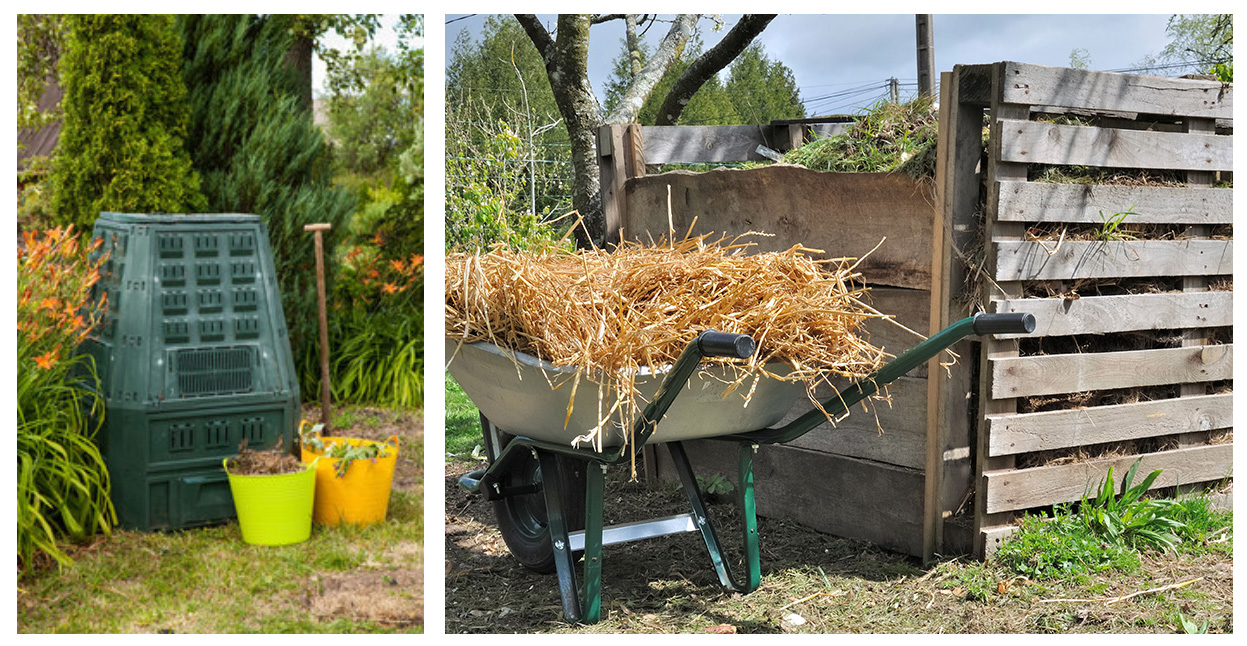 design or DIY the choice is yours
For us at Olivo Tappeti, the environmental awareness is very important, as our catalogue shows, with more than 80% of recyclable products and many more made from recycled materials, and lines in natural cotton.
Do you want to know your nearest dealer?
Enter your postcode and your e-mail address to receive a list of shops in your area.
Error: Contact form not found.