Study the lighting in your home for maximum comfort in every room.
by Anna Baldo
In a room, lighting really makes a difference; it can change the character, aesthetic quality and even the comfort of a room. That is why we asked an expert for advice on the subject, Claudio Cervelli, lighting designer with extensive experience in museum, theatre, civil engineering and event lighting design.
 designing the lighting of a room
Tips on how to light a room
OT: What exactly are we talking about when we address the subject of lighting in a house?
C.C.: From my point of view, whether it is a public, professional context, or the design of lighting for a house, my work is always a mixture of technique and imagination, of taste (of the client, but also mine) and necessity, and it always involves projects tailored to the context. In any case, the fundamental theme to be addressed is energy saving, an obligation not only moral, but also given by the rules and the market itself.
Today, the most wasteful light sources, such as incandescent bulbs, are finally being phased out, and LEDs and low-energy lights are becoming more readily available. The sense of responsibility towards energy saving is increasingly widespread, and fostered by the system at large. 
OT: Looking at how to organise lighting in the home, what should we take into account?
C.C.: Let us make a general premise.
The regulations speak of calibrating the brightness according to the activities taking place in a room, or in an area.
The higher the attention needed (i.e. where a precision or work task is being performed), the higher I will have to keep the brightness, also increasing the degrees Kelvin (i.e. going towards cold light).
This guiding principle can accompany us when examining the various rooms in the home. In general, I advise against using cold lighting, which gives the room a hospital-like, unwelcoming appearance.
Better to stay on a natural temperature, between 3000 and 3500 K.
OT: Let's start with the kitchen, the heart of the house.
C.C.: The kitchen is an example of a room where precision activities, such as cutting and preparing food, take place.
In the areas where this occurs, there should be a focused, concentrated light of a good level and not too yellowish.
Spotlights under wall cabinets, above the worktop, or even LED strips, adhesive light strips, are very easy to apply and very effective where I need to add brightness directed towards a work area.  Light in the kitchen
OT: What suggestions do you have for the dining room?
C.C.: On the table for lunch or dinner I recommend having a concentrated light, in contrast to the rest of the room, which may be slightly shaded.
As long as one is eating, one needs to see the food well, both because tasting begins with sight and from a practical point of view. Excellent are the pendant lights, which illuminate the table without hitting the diners' faces, but also the table centre lamps, soft light abatjours, perfect for special occasions or outdoor dining, also available with battery charging, and very elegant in design. 
OT: Let's talk about the sofa area.
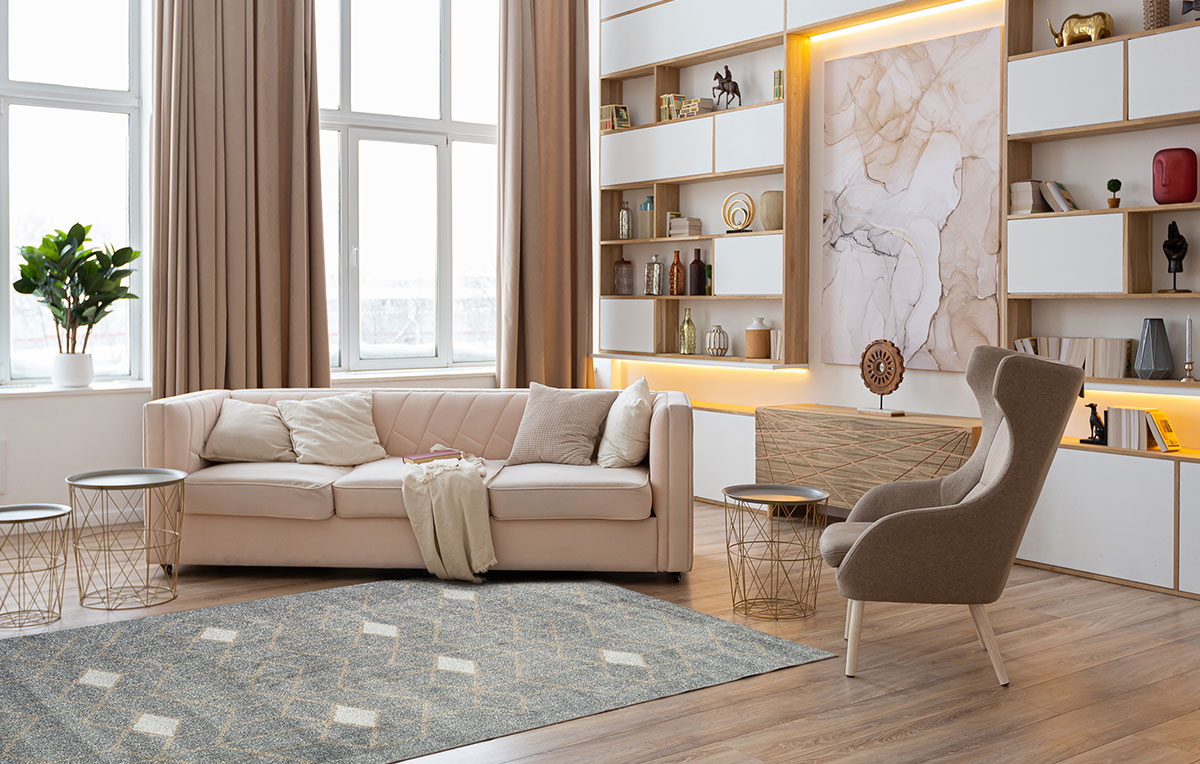
C.C.: Here we are in the relaxation area, so the lights become warmer and softer. For better TV viewing, a light behind the monitor helps not to tire the eyes.
For the rest, you can play freely: you can point spotlights at a painting or an object to highlight, add lamps focused on the reading area.
As in a theatre, one can envisage the possibility of controlling the lights remotely, making a real lighting direction and choosing where to place the accent; in fact, transforming the room according to its use, creating ad hoc settings for dinner, reading, chatting with friends and so on.
OT: How do carpets relate to lighting?
C.C.: I carpets are a “light-friendly” surface.
A carpet with a pattern catches the light and visually stands out well against the floor, even in low light.
Even though it is ton-sur-ton, the carpet represents an opaque surface, captures the light reflected from the ceiling and walls, as well as from light spots, and does not need anything else to stand out. 
OT: Does it change anything, thinking about the bathroom?
C.C.: The bathroom is also one of the rooms where actions requiring precision (from shaving to make-up) take place, and so here I tend to allow a cooler light, around 4000K.
A really chic detail is to choose a dimming light to be placed around the mirror, to allow for variable white, as required.
A tip for ladies who wear make-up: apply make-up using the light that will be in the room you are going to; if you are applying make-up to go to the theatre, create a warm, yellowish light; if you are going to the office, reproduce a light, cooler light environment.
The colour palette you choose for make-up will also be more appropriate.
The extra touch, finally, is to transform the bathroom at home into a small wellness centre, in a simple way.
In the shower you can play with lights by adding colours and recreating a true “colour bath”.
This is also where LED strips come to the rescue, which are also available with rotating colour change. with the right light the bathroom resembles a spa
OT: We thank Claudio Cervelli for the helpfulness and practical tips on how to light a room
Do you like these carpets?
Do you want to know your nearest dealer?
Enter your postcode and your e-mail address to receive a list of shops in your area.
Error: Contact form not found.